Dublin Core
Title
Emblem of Strength and Courage
Description
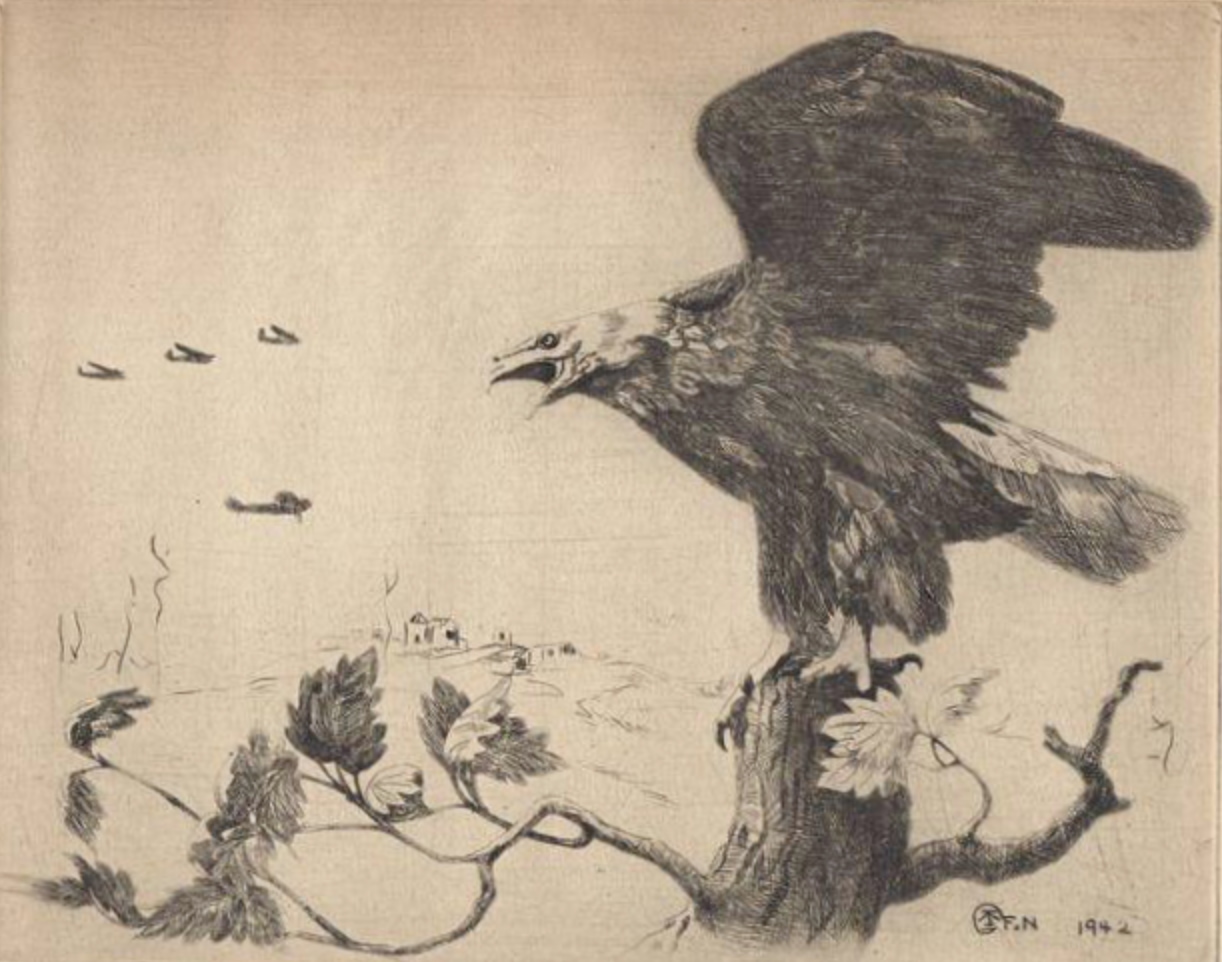
An eagle sits atop a blasted tree, apparently screeching at four planes flying overhead. Nakamizo's print was selected for inclusion at a 1943 exhibition sponsored by Artists for Victory, and can be taken as an afirmation of American resistance to Axis militarism. The image is complicated, however, by Nakamizo's internment at the Topaz War Relocation Center in Utah at the time his lithograph was created. A small structure in the background and lines suggestive of rising smoke also suggest a broader critique of war, which he was experiencing at first hand.
Note: an image of Nakamizo's print, formerly viewable at the Library of Congress website, has been removed. This low-resolution image comes from a 2011 traveling exhibit created by the Smithsonian American Art Musueum, The Art of Gaman: Arts and Crafts from the Japanese American Internment Camps, 1942 – 1946 Link. It's included here as an important accompaniment to Nakamizo's other paintings and lithographs of birds.
About the Artist: Born in Fukui Prefecture, Japan, Nakamizo—whose name sometimes was spelled “Fugi”—immigrated to the US in 1907, living in Grand Rapids, MI and working as a decorator. He later moved to New York and studied at the Art Students League with Frank DuMond and Joseph Pennell. During the early 1920s, he appears to have created an etching of the medical researcher Dr. Hideyo Noguchi that hung in the Nippon Club, New York (Piper). By the 1930s he was fairly well known, especially for his etchings of birds, and exhibited at places like the League Gallery (1933), Montross Gallery (1934), the Brooklyn Museum (1935), the Art Institute of Chicago (1935); and the Carl Fischer Gallery (1936). In 1936 he contributed photographs and illustrations to feminist author Baroness Shidzue Ishimoto’s East Way, West Way: A Modern Japanese Girlhood. In 1943, Nakamizo’s etching “Emblem of Strength and Courage” was chosen for a national exhibition sponsored by the group Artists for Victory; this painting of an American eagle surrounded by warplanes may have been ironic, since some sources place him at a Japanese internment camp during World War II. 2 works at Smithsonian American Art Museum. 3 works at Lowe Art Museum. 6 works at Queens Library. 1 work at the National Gallery of Art. 6 more images at FAP.
Sources Consulted: Jean Piper, “Scientist Acts Like Human Dynamo,” Brooklyn Daily Eagle 6 Mar. 1927: 85; Ellen G. Landau, Artists for Victory: An Exhibition Catalog (Library of Congress, 1983).
Note: an image of Nakamizo's print, formerly viewable at the Library of Congress website, has been removed. This low-resolution image comes from a 2011 traveling exhibit created by the Smithsonian American Art Musueum, The Art of Gaman: Arts and Crafts from the Japanese American Internment Camps, 1942 – 1946 Link. It's included here as an important accompaniment to Nakamizo's other paintings and lithographs of birds.
About the Artist: Born in Fukui Prefecture, Japan, Nakamizo—whose name sometimes was spelled “Fugi”—immigrated to the US in 1907, living in Grand Rapids, MI and working as a decorator. He later moved to New York and studied at the Art Students League with Frank DuMond and Joseph Pennell. During the early 1920s, he appears to have created an etching of the medical researcher Dr. Hideyo Noguchi that hung in the Nippon Club, New York (Piper). By the 1930s he was fairly well known, especially for his etchings of birds, and exhibited at places like the League Gallery (1933), Montross Gallery (1934), the Brooklyn Museum (1935), the Art Institute of Chicago (1935); and the Carl Fischer Gallery (1936). In 1936 he contributed photographs and illustrations to feminist author Baroness Shidzue Ishimoto’s East Way, West Way: A Modern Japanese Girlhood. In 1943, Nakamizo’s etching “Emblem of Strength and Courage” was chosen for a national exhibition sponsored by the group Artists for Victory; this painting of an American eagle surrounded by warplanes may have been ironic, since some sources place him at a Japanese internment camp during World War II. 2 works at Smithsonian American Art Museum. 3 works at Lowe Art Museum. 6 works at Queens Library. 1 work at the National Gallery of Art. 6 more images at FAP.
Sources Consulted: Jean Piper, “Scientist Acts Like Human Dynamo,” Brooklyn Daily Eagle 6 Mar. 1927: 85; Ellen G. Landau, Artists for Victory: An Exhibition Catalog (Library of Congress, 1983).
Creator
Nadamizo, Fugi, 1889-1950
Publisher
US Library of Congress
Date
1942
Contributor
Cooper, Ken
Source
Beth Secor, " 'The Art of Gaman' at the Holocaust Museum Houston," Glasstire 28 July 2015 Link
Format
jpeg, 267 KB
Type
Still image
Still Image Item Type Metadata
Original Format
Lithograph