Dublin Core
Title
Description
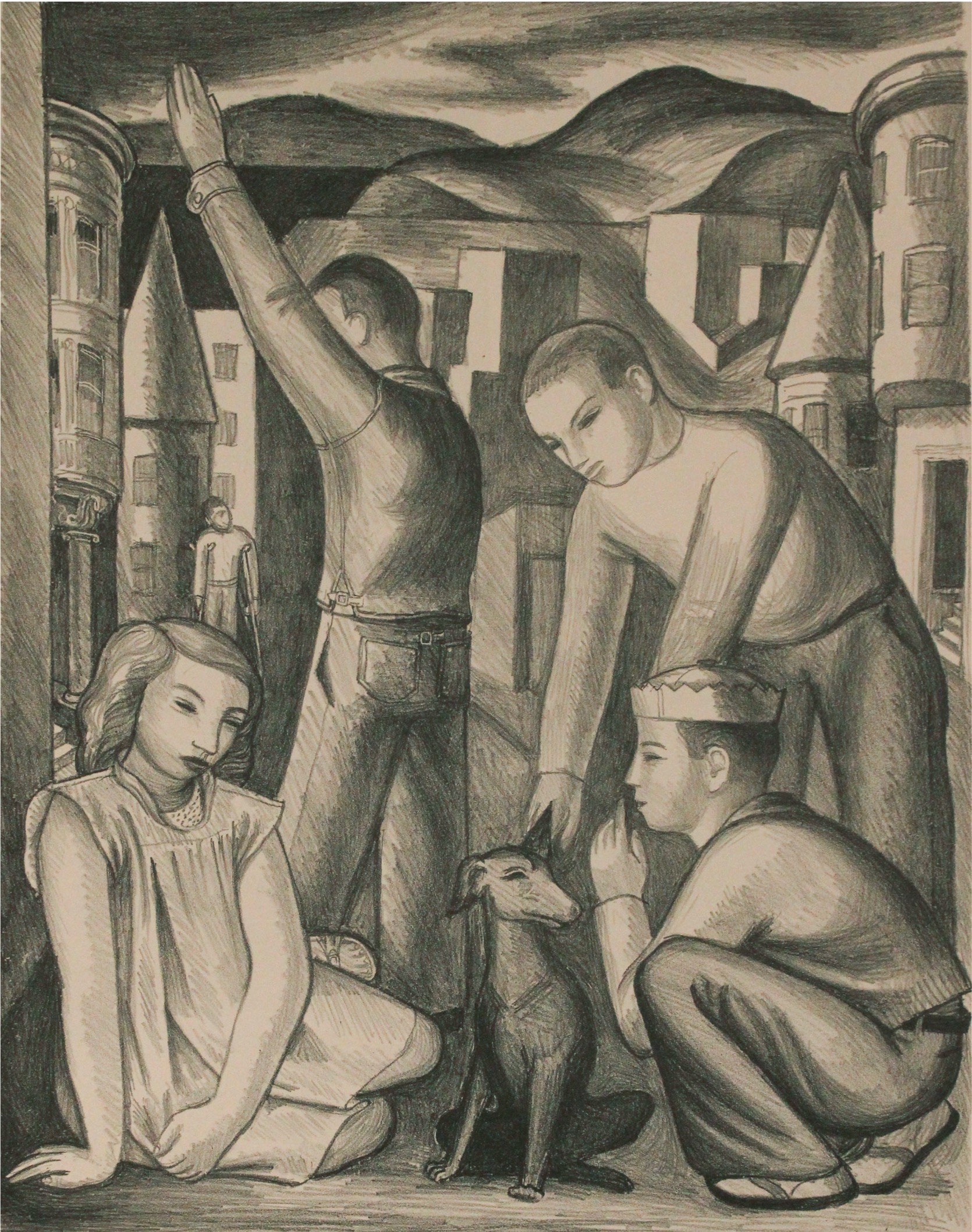
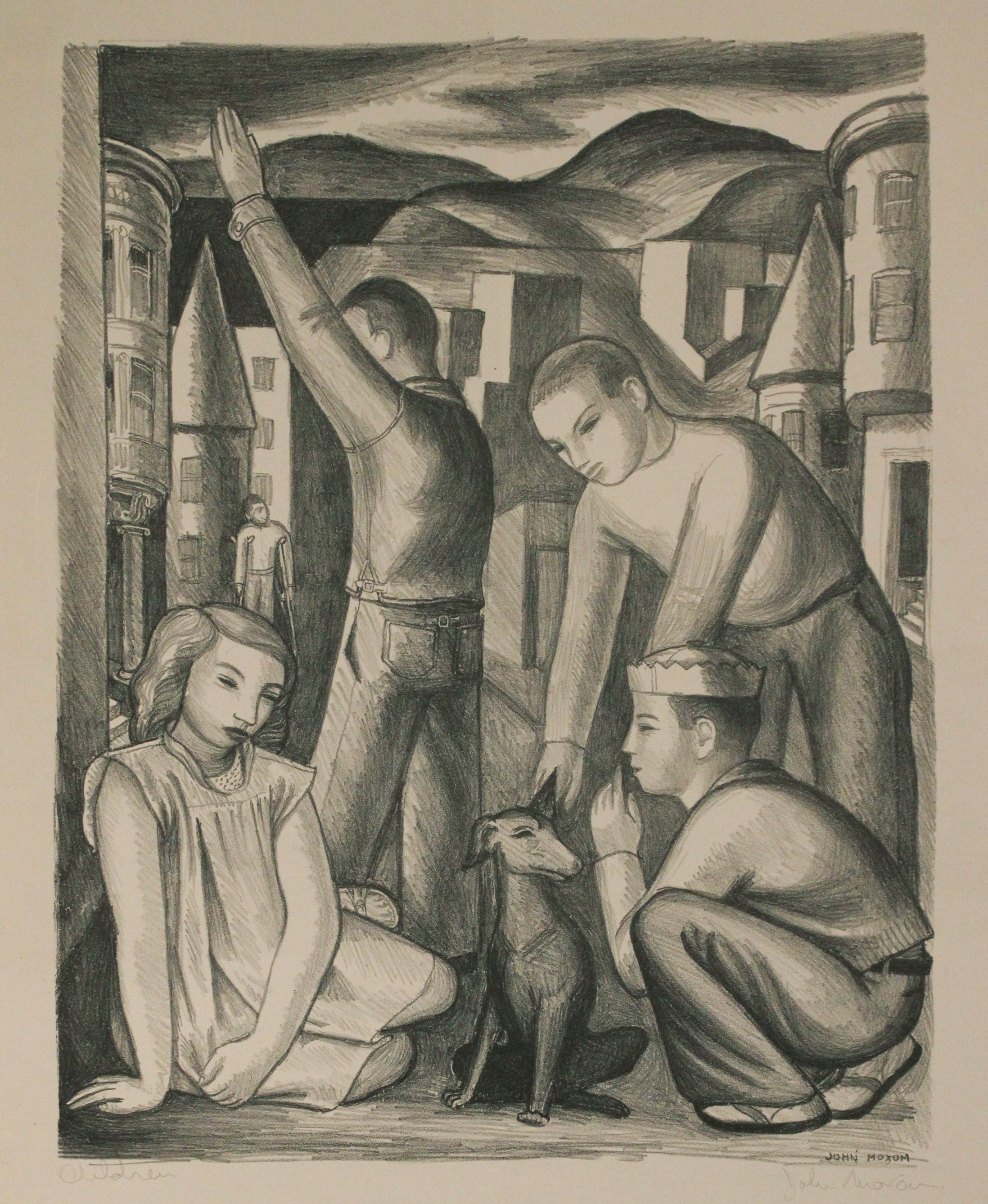
In the foreground are four children and a dog, each making a somewhat inscrutable gesture. Behind them, in the middle ground, another child walks toward them using a pair of crutches—again, leaving us to speculate as what has happened and the relationship between him and the other children. The seemingly urban setting of Moxom’s scene feels quite crowded, almost like pieces in a puzzle. A few hills in the distance provide the only sense of spaciousness; in fact, the abstract buildings resemble very large building blocks, and even more strangely their shapes are echoed in the organic figures: one boy’s hat and the rounded turret; a cupula and the dog’s ears; various body parts and planes of structures. Moxom uses tonal shading to create three-dimensional, even sculptural forms. Perhaps there’s a suggestion that the world of children and their “games” are deeply immersive, or that childhood is itself a strange construct. Both the subject matter—children—and Moxom’s rendering of figures have similarities to his earlier FAP work on murals.
About the Artist
John (“Jack”) Swanston Moxom was born in Calgary, Alberta, immigrating with his family to San Francisco in 1925. He lived in the Bay Area the rest of his life. Moxom studied at the California School of Fine Art, then received his first commission through the FAP for a sculpture at the Sarah B. Cooper Memorial, Golden Gate Park. His subject matter of a young girl with a cat and a squirrel at her feet seemed appropriate to honor the educational reformer. Moxom later recalled, however, that his inexperience led him to choose a variety of sandstone that was beautifully flesh-colored but “darkened to a bloody red when the water hit it” (McChesney). Moxom’s main artistic contributions to the FAP took the form of murals at what was then called the San Francisco Teachers College (now SF State). Over two years, he created an estimated 10-15 separate murals ranging from a 12’ x 9’ work for a childrens’ library, to various works integrated into a building’s architecture (“Frederic Burk”). Eventually the murals were painted over, until a 2015 restoration project converted 55 Laguna Street into affordable senior housing for the LGBTQ+ community. Moxom also worked at the Hillsborough District School to create a 60 ft. painted mural for its auditorium, depicting the conquistador Juan Bautista De Anza encountering a variety of Native Arts (McChesney; SF Art Ass’n). In later years Moxom studied with the Italian painter Giorgio de Chirico, but he always credited the FAP’s support for young artists: “...some place for a studio, some facilities to make a beginning, some nucleus would permit the painter to live on a restricted budget....It's deadly, competition. Partly because most of us would always lose and those who win might not be the best ones. I mean, God himself couldn't tell what the results are going to be before we've begun” (McChesney). 2 works at the Philadelphia Museum of Art. 1 work at Detroit Museum of Art. 1 work at the Annex Galleries. 3 images at GSA.
Creator
Publisher
Date
Contributor
Helquist, Morgan (photography)
Source
Object #FA 1337
Format
jpeg, 1.4 MB