Working Bodies


One of Franklin D. Roosevelt’s earliest “fireside chats” was broadcast on radio July 24, 1933, to explain and mobilize support for what he called national recovery. “We are not going through another winter like the last,” he avowed, recalling the previous year’s misery caused by deflation and unemployment rates approaching 25%. People had suffered while there were “professional economists who insist that things must run their course.” Instead, the New Deal was actively putting “300,000 young men into practical and useful work in our forests and to prevent flood and soil erosion. The wages they earn are going in greater part to the support of the nearly one million people who constitute their families.” This is only one instance of how, during the Great Depression, shared understandings of health were often tied to usefulness—whether a person still could work and contribute.
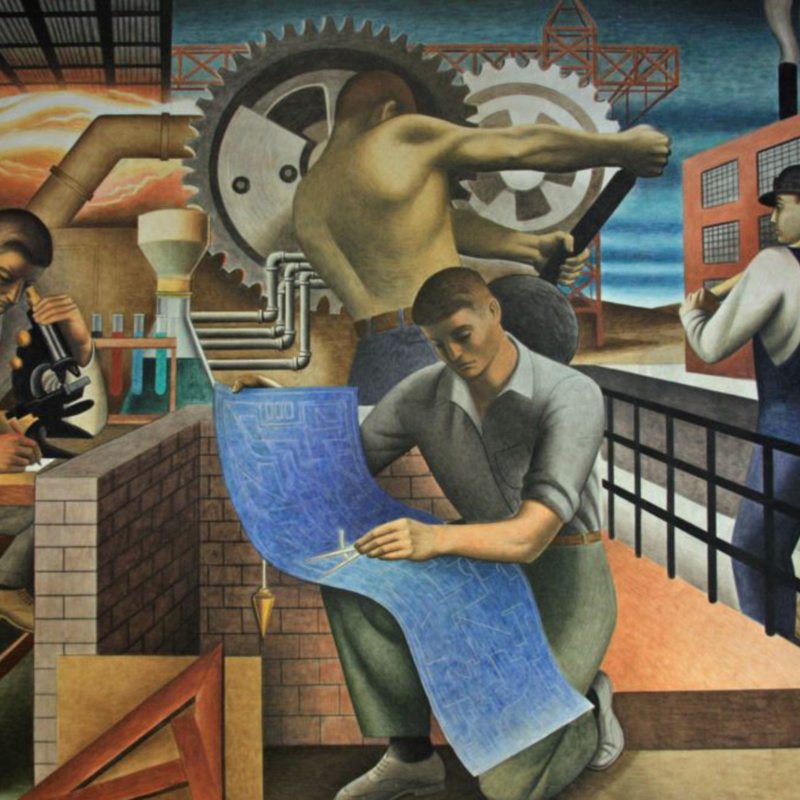
In Roosevelt’s talk, the working body, the healthy body, and the body politic were nearly indistinguishable. But it also exposed the hazards of modern life: although work was framed as both a sign of wellness and a civic ideal, couldn’t it also strain, injure, and shorten life? The productive body was a resource (labor) measured by output within an industrial economy; Roosevelt’s warning that “there should be no discord and dispute” in seeking additional workers’ rights kept his metaphor of health within normative boundaries. Unionized bodies were an unwanted variable. More heavily vetted works of New Deal art tended to follow Roosevelt's logic, like Seymour Fogel’s “The Wealth of the Nation,” a 1937 mural created for the US Treasury Department’s Section of Fine Arts. Manual and intellectual labor alike are embodied in healthy specimens of manhood, all contributing to the country’s well-being. But Arthur G. Murphy’s bridge worker has a rude strength and massiveness that edges beyond (or before) the human, suggesting that a body only working may lack fully realized personhood.
Another way to appraise the working body is through tuberculosis—that is, a person who survived hospitalization and was living with a “partial arrest” of the disease. Such patients were “forced by the financial strain which is the natural concomitant of months of idleness to return to work as soon as their strength seems to permit” (Klein and Thorburn 5). A 1928 study concluded that such individuals needed “advice on health, job and family life—all from the health standpoint” (8). Its dizzying list of restrictions concerning suitable work had the effect of revealing the brutality of normal production: physical strain, 12-hour shifts, dust, extremes of temperature, “piecework of any kind under high tension,” processes that used toxic chemicals..."in short, any work that was a heavy tax on the patient’s vitality or in particular on the chest and lungs" (12-16).
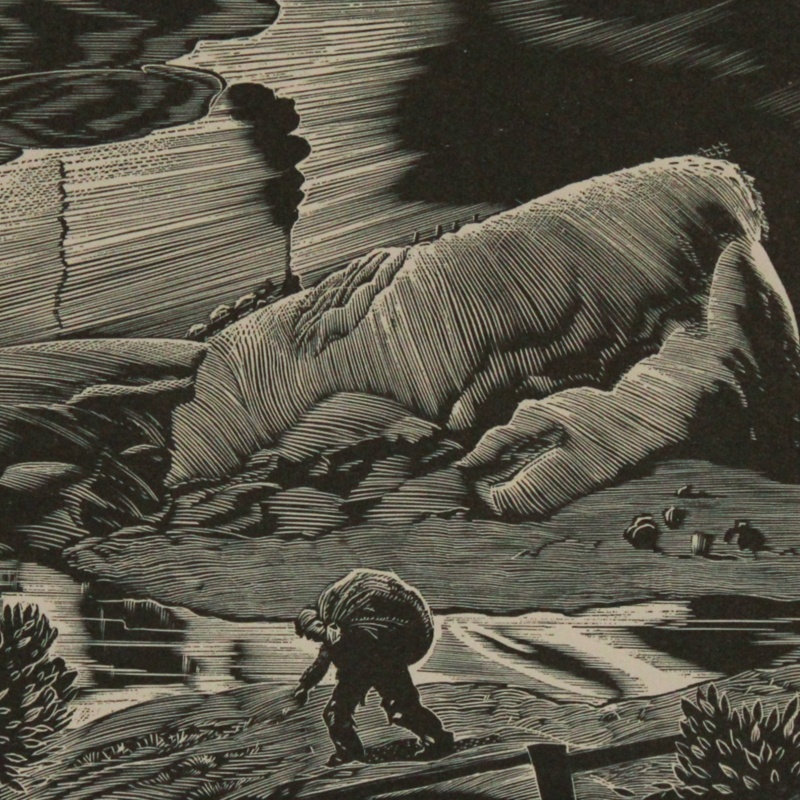
The demands of productive work, in other words, creates a body politic that never can be healthy due to massive contradictions. Robert Moir’s Winter Day (c. 1935) is typical of many New Deal prints using that medium to evoke industrial landscapes from which there seems to be no escape—here, a pair of smokestacks whose pollutants leach into the shading of even a church. A few humans appear as barely defined scribbles. Charles E. Pont, a Baptist minister and artist, creates an apocalyptic vision from the reality of the Corona Ash Dump in Queens, at that time being rebuilt as the 1939 World’s Fair. Westinghouse’s “Hall of Electrical Living” contributed to the Fair’s theme of “The World of Tomorrow” by producing “a forecast of the future as foretold by the industrial and technical developments of today” (156). Pont’s focus, however, is upon a single figure in the foreground, perhaps like other denizens being evicted from Flushing Meadows. Looming high above this individual is the waste produced by working bodies.
Works Consulted
-- Klein, Alice Campbell, and Grant Thorburn, MD. Employment of the Tuberculous: An Experiment in Medically Supervised Employment for Patients Recovering from Tuberculosis. New York Tuberculosis and Health Association,1928. Courtesy of Internet Archive. Link
-- Official Guide Book, New York World’s Fair 1939. Exposition Publications, 1939. Link
-- Roosevelt, Franklin D. “Fireside Chat (Recovery Program).” 24 July 1933. Online by Gerhard Peters and John T. Woolley, American Presidency Project. Link